
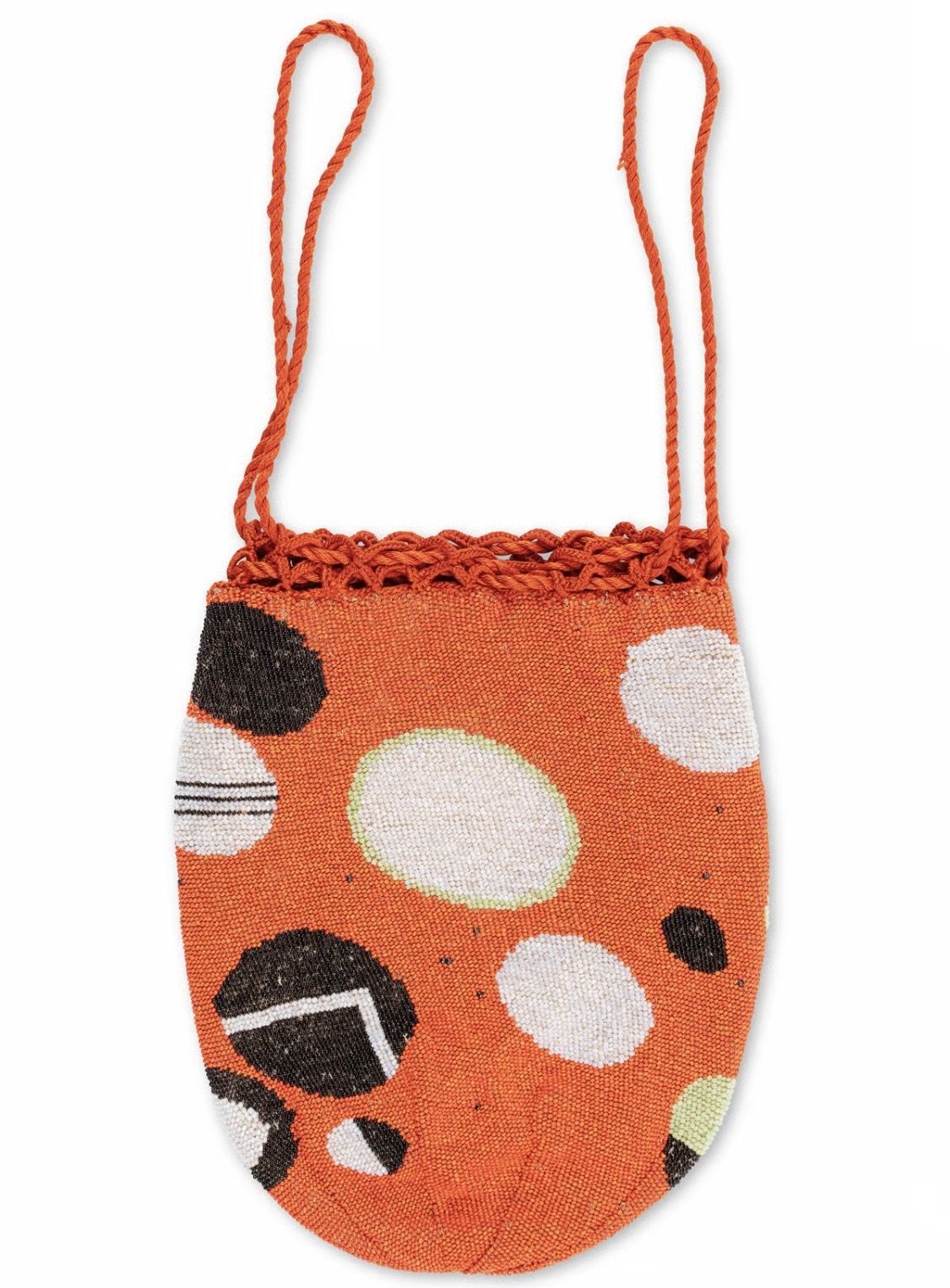
Maria Likarz-Strauss (1893-1971),
Pouch/evening bag with glass beads.
Manufactured by: Wiener Werkstätte, Vienna 1925.
Provenance: private collection Christa Ehrlich (1903-1995)
Maria Likarz-Strauss (1893-1971)
Description
Maria Likarz-Strauss (1893-1971),
Pouch/evening bag with glass beads.
Manufactured by: Wiener Werkstätte, Vienna 1925.
Provenance: private collection Christa Ehrlich (1903-1995)
Christina Anna (Christa) Ehrlich (Vienna, March 12, 1903 – The Hague, February 12, 1995) was a visual artist who gained fame as a jewelry designer, photographer, and goldsmith.
Biography
Ehrlich was trained at the Kunstgewerbeschule in Vienna (1922-1925), where she was taught by Josef Hoffmann, among others. Commissioned by Hoffmann, Ehrlich was responsible for part of the interiors of the Austrian pavilion at the Exposition des Arts Décoratifs et Industriels in Paris in 1925, one of the most modern pavilions at this world exhibition.
In 1927, she met Carel Begeer at the Europäische Kunstgewerb exhibition in Leipzig.[5] He invited her to work as a designer of tableware for the Zilverfabriek Voorschoten, a subsidiary of the Royal Dutch Precious Metal Companies. There, she designed, among other things, geometric tea sets with a sleek design.[6][7] She made use of a modular design system of shapes in different sizes, which could be combined into various objects.[5] The company merged with the Van Kempen en Begeer company in 1960. After her arrival in the Netherlands, her work was quickly noticed and published, and in that same year (1927) she designed a cover for the magazine Wendingen, which was dedicated to the Wiener Werkstätte. Ehrlich also designed ceramics for the Maastricht company Regout. She maintained contacts with Hendrik Petrus Berlage, Hendrik Wijdeveld, and Jan Eisenloeffel. Her design is based on industrial production.
She continued to work for the Zilverfabriek Voorschoten until her retirement. Between 1928 and 1960, Ehrlich designed all the exhibitions in which the Zilverfabriek participated. In addition, she also designed the catalogues, brochures, packaging material, and monograms for the factory. After the war, she no longer created new designs for silver objects for the factory.[8] Ehrlich died in The Hague in 1995.
Source: Wikipedia